
In precision electronic applications such as industrial control, automotive, new energy, and communication equipment, resistors are fundamental components for current division and voltage division. Ordinary resistors and sulfur-resistant resistors are designed to adapt to different application scenarios based on varying usage environments and cost requirements.
I. Internal Electrode Material
- Ordinary Thick-Film Chip Resistors
The mainstream uses a silver-palladium electrode system, with the inner layer of the end electrode being a silver-palladium alloy and an outer layer of nickel or tin protective coating. Silver has excellent conductivity, moderate raw material costs, and mature sintering processes, making it a common solution for consumer electronics and general indoor equipment. The chemical activity of silver itself is strong, and it is prone to chemical reactions when exposed to sulfur elements. This is an inherent material property, not a product defect.
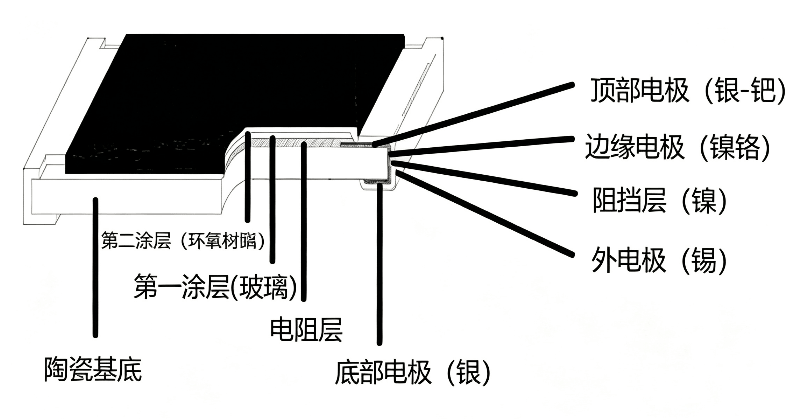
Thick-Film Resistor Structure
- Sulfur-Resistant Resistors
The core modification is a barrier-type electrode or a modified noble metal electrode, with two mainstream technical routes:
1. Significantly increasing the palladium content, reducing the proportion of silver, and decreasing the carrier for silver-sulfur reactions;
2. Adding multi-layer sealed barrier coatings (nickel-vanadium, thick nickel barrier layer, special resin protective layer) to physically isolate external sulfur gases. Some high-end automotive-grade sulfur-resistant resistors use silver-free electrode structures to eliminate sulfurization reaction conditions from the source.
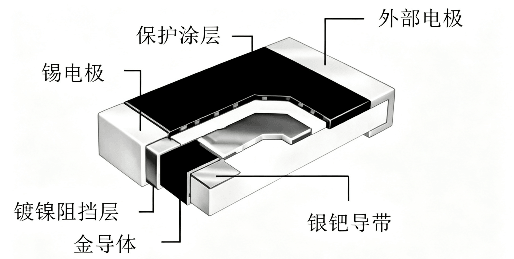
Sulfur-Resistant Resistor Structure
II. Palladium (Pd) Noble Metal Proportion (Core Key of Sulfur Resistance)
The root cause of sulfur failure is the reaction of silver (Ag) electrodes with sulfur ions to form insulating silver sulfide, blocking the conductive path. Palladium metal can block sulfur ion penetration, making it the core material for sulfur resistance:
- Ordinary Resistors
The front electrode only has a low palladium ratio of 0.5% Ag/Pd, and some low-cost products have no palladium at all. The silver layer is completely exposed, and sulfur gas easily corrodes the electrode.
- Sulfur-Resistant Resistors
The front electrode uses a high palladium ratio of 5% Ag/Pd, and a dense protective barrier is formed by high palladium content, blocking sulfur elements from entering the silver electrode.
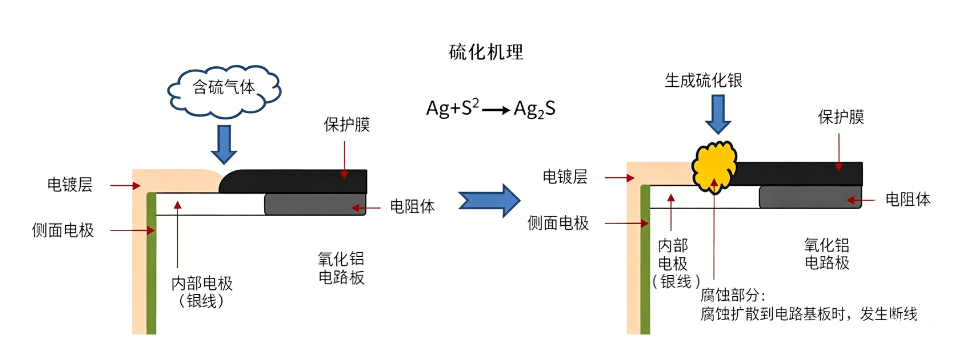
Resistor Sulfurization Process
III. Power and Precision Design
- Ordinary Resistors
Standard general-purpose power structure, thin film layer, weak overload capability; supports conventional precision laser cutting, with a mainstream tolerance of ±1% and ±5%, suitable for ordinary voltage division and current limiting circuits.
- Sulfur-Resistant Resistors
Uses a thick film layer and high power structure, capable of higher power under the same packaging; combined with high-precision laser trimming process, the resistance tolerance can reach ±0.5% and ±0.25%, suitable for precise sampling and signal detection circuits.
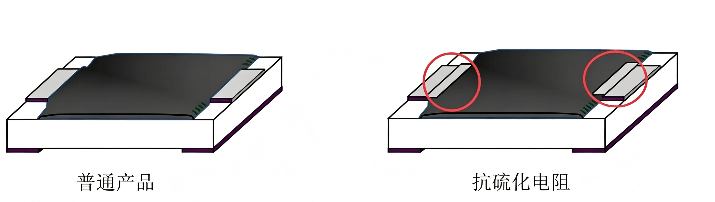
Sulfur-Resistant Resistors are coated with an additional high-thermal-conductivity polyurethane encapsulant for protection.
IV. Visual Comparison of Microscopic Cross-Section
The image micro-section clearly shows the electrode state after long-term sulfur testing of the two types of resistors:

Left: Sulfur-Resistant Resistor Right: Ordinary Resistor
Ordinary Resistors: The surface layer of the electrode shows a large area of loose corrosion yellowing layer, with silver electrodes corroded by sulfur forming an insulating silver sulfide layer, severe electrode delamination and porosity, leading to resistance value drift and eventually open circuit during use.
Sulfur-Resistant Resistors: The electrode edge marked in red is intact and dense, with no holes or corrosion peeling. High palladium electrodes plus anti-sulfur composite coating firmly lock the metal layer of the electrode, preventing sulfur ions from penetrating, keeping the conductive structure of the electrode intact, with no resistance value deviation.
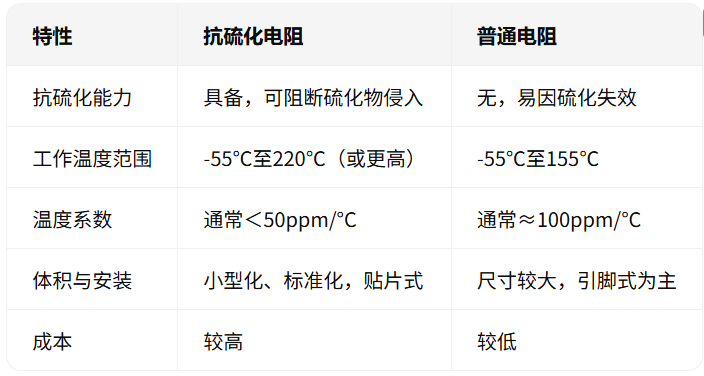
V. Comparison between Sulfur-Resistant Resistors and Ordinary Resistors
 041683925749aebf9791b6c169cf27.png" alt="" />